


Posted by Bereli on 12th May 2025
The Steyr AUG: A Revolutionary Bullpup in Military History
Few firearms have left as distinct a mark on modern military design and the culture as the Steyr AUG. Officially named the Armee-Universal-Gewehr (Universal Army Rifle), and if you say the acronym as opposed to the German version (if you’re a know-it-all) it is pronounced A-U-G; not AWGE. The AUG was developed in the 1970s by Steyr-Daimler-Puch of Austria. Combining futuristic, put-of-a-movie aesthetics with innovative engineering, the AUG was one of the first successful bullpup-configured assault rifles, and it still sees use in dozens of military forces today alongside the weekend-warriors and hobbyists.
The AUG’s impact lies not only in its unique appearance but in its performance, modularity, and forward-thinking design. Our article will tell you about the development, service history, and various configurations/options of the Steyr AUG. So rest assured we got ya covered! And we will also explain the nuance differences between the Standard and NATO variants and why you might want to spend the extra $100.00 or save it. Although on our site, not to pat our own shoulders, you’ll find them at the same price because we’re chill like that.
Origins and Development
In the post-World War II era, most Western militaries were reevaluating their standard-issue rifles. Austria, having relied on tired weapons for decades, sought to develop a modern rifle that reflected both the technological advances of the Cold War and the tactical needs of modern infantry.
Design work on the AUG began in the late 1960s, spearheaded by Horst Wesp, Karl Wagner, and Helmut Senoner. By 1977, the rifle was adopted by the Austrian Army as the StG 77 (Sturmgewehr 77). From the beginning, the AUG was designed to be a versatile, all-in-one platform that could serve as a rifle, carbine, or light support weapon with minimal reconfiguration. And yeah, it is that super lightweight!
Bullpup Design and Features
Steyr AUG is perhaps most recognizable for its bullpup layout, in which the action and magazine are located behind the trigger and serves better for close-quarter combat scenarios. This design provides a full-length barrel in a much shorter overall package, increasing maneuverability without sacrificing ballistic performance. Essentially, in simpleton terms, there is less recoil because the center of gravity is closer to the chest.
Key Features:
- Quick-change barrel system for different roles
- Ambidextrous polymer body, though early ejection was right-side only
- Modular design: the rifle could be reconfigured quickly with minimal tools
- Super-rad aesthetics
- A co-star in many movies such as Die Hard (Bruce Willis), James Bond (with Daniel Craig), and many more!

The AUG was built primarily with advanced polymers (a very very strong plastic) and aluminum, making it super lightweight, and it featured a translucent magazine AKA the infamous Waffle Mag— believe or not, an unheard of idea for its time — to allow soldiers to see remaining ammunition at a glance. No more guess work!
Service History
Since its adoption in 1977, the Steyr AUG has been fielded by over 30 countries, including Ireland, Australia, New Zealand, Argentina, and Malaysia. It has been produced under license in several nations and adapted to suit different operational needs.
Australia’s F88 Austeyr
One of the most prolific adopters is Australia, which licensed and locally produced the AUG as the F88 Austeyr. Variants of this rifle have seen combat in Afghanistan, Iraq, and East Timor, proving the AUG’s durability in modern conflicts. The primary difference was the raised mounting-rail.
Special Forces Use
The AUG has also been favored by various special forces units for its compact size, reliable action, and modularity, including Ireland’s ARW and Malaysia’s GGK.
Variants and Upgrades
Over the decades, Steyr has released multiple versions of the AUG, with improvements in ergonomics, optics, compatibility, and obviously coolness.
Notable Variants:
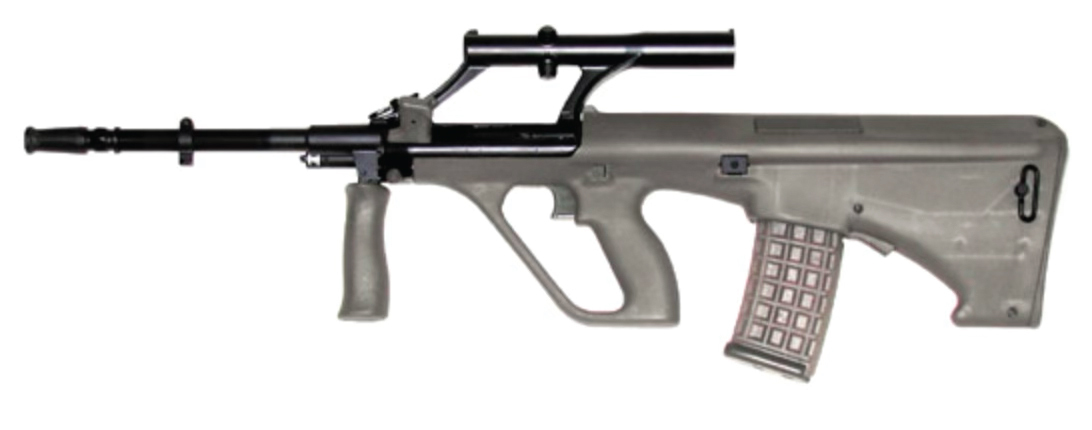
- AUG A1 – The original model with integrated scope
- AUG A2 – Same as A1 but with a Picatinny rail instead of fixed optic
- AUG A3 – Modernized version with full rail system and modular upgrades
- AUG HBAR – Heavy-barrel version for squad automatic weapon role
- AUG Para – Chambered in 9×19mm for police and SMG use
- A3 M2 - Current model
Each of these variants maintains the core bullpup system but adapts to changing needs and combat environments.
Standard vs. NATO Versions: Key Differences
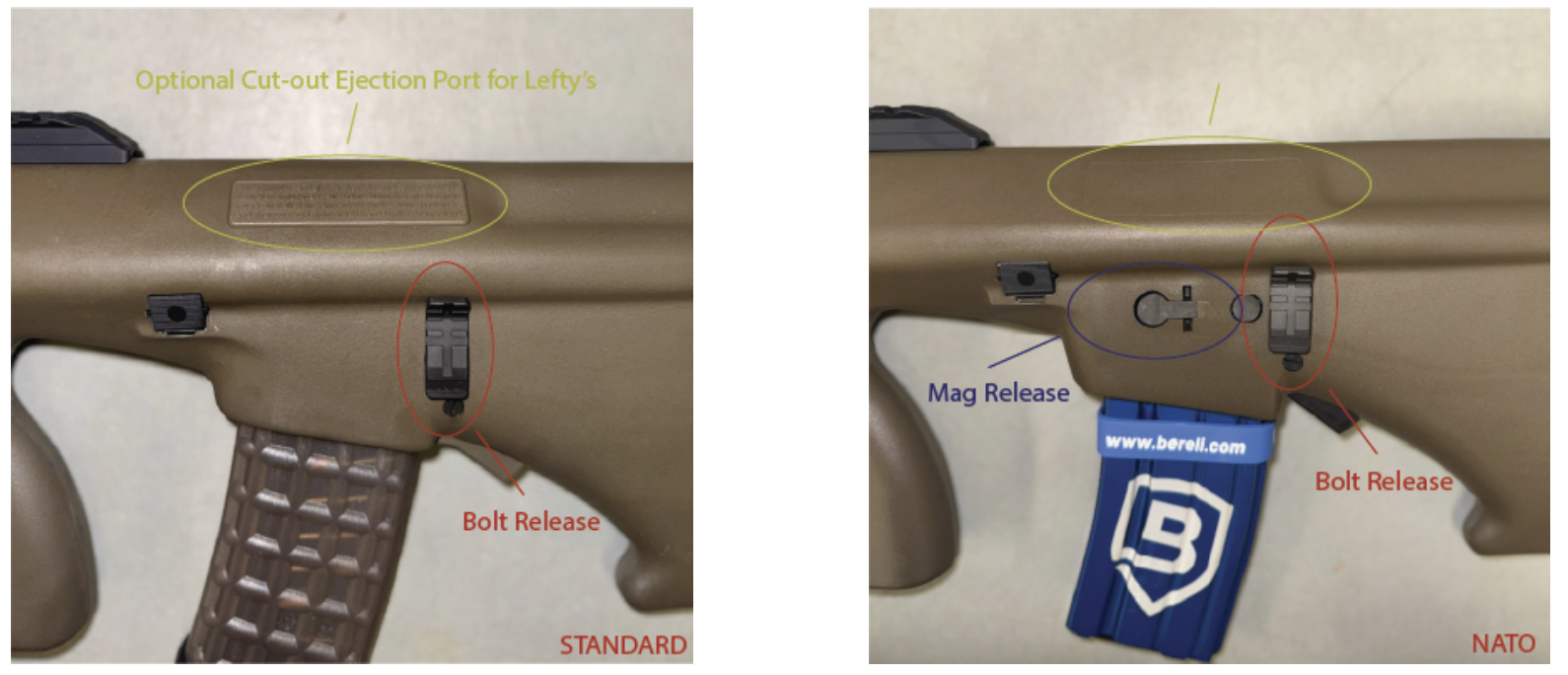
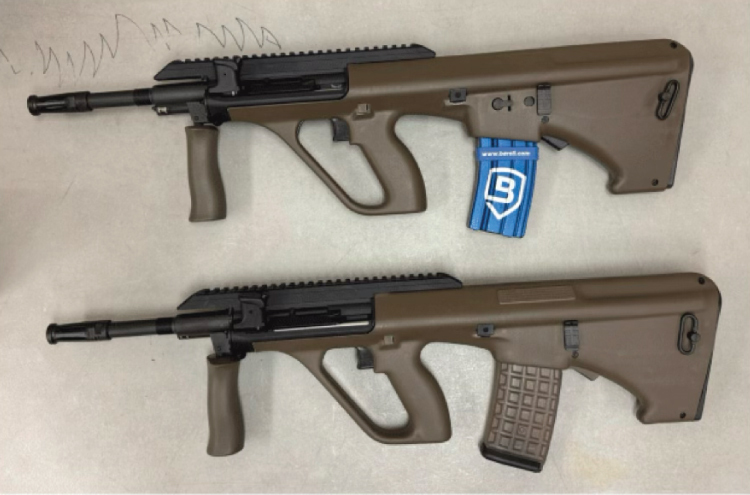
Significant divergence in the AUG lineup is between the Standard (AUG A1/A2/A3) models and the NATO variant (often designated AUG A3 NATO). These changes were made primarily to appeal to NATO-aligned forces, particularly the U.S. market.
Magazine Compatibility
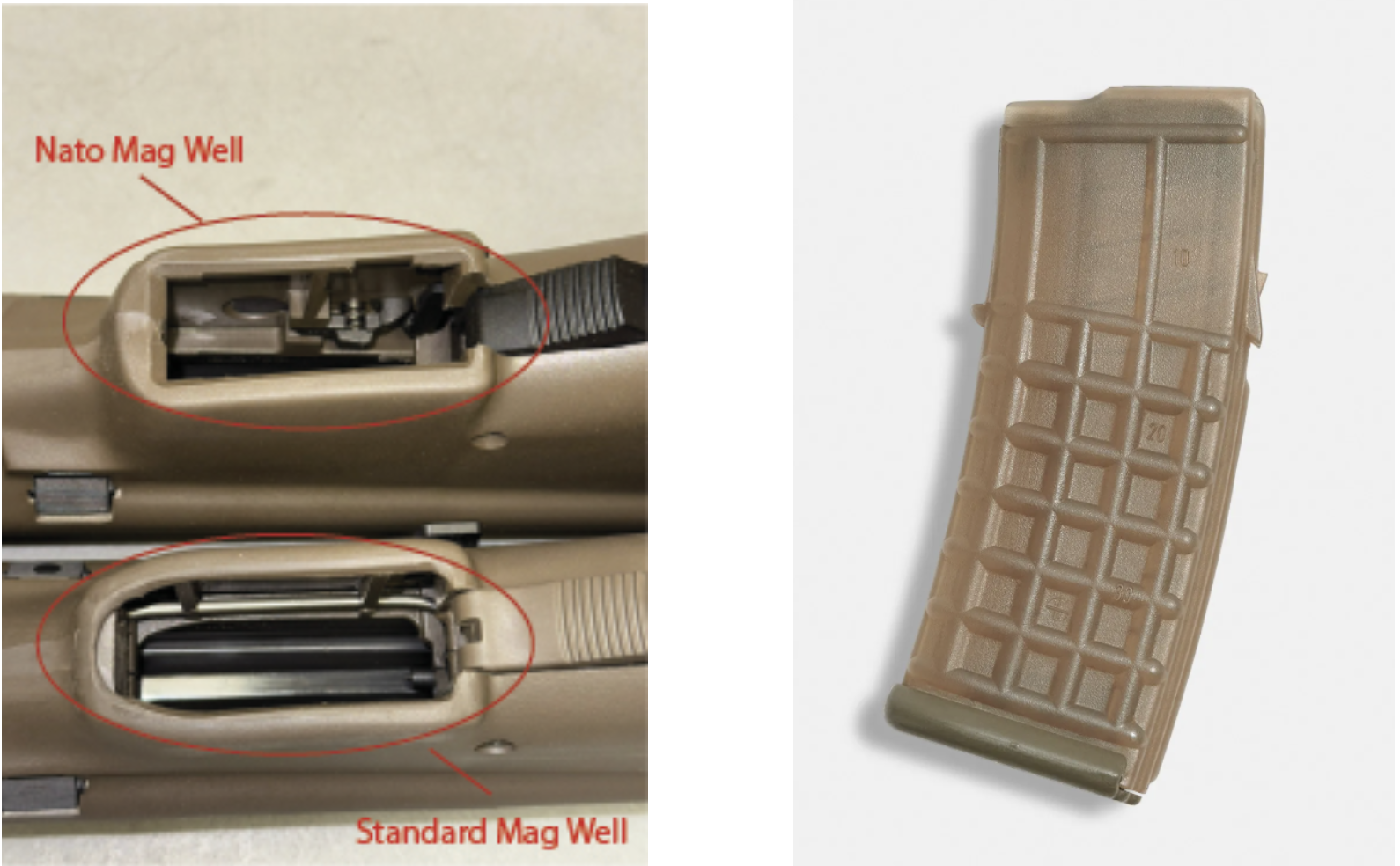
- Standard AUG uses proprietary translucent Steyr magazines.
- NATO AUG uses STANAG magazines, the same as the M16/M4 platform.
- ➡️This was a major shift, allowing military and civilian users to standardize ammunition and magazine logistics across platforms.
Bolt and Receiver Design
- The NATO variant features a modified bolt and magazine well to accommodate STANAG mags, while the standard version retains Steyr's proprietary system.
- Some A3 NATO versions also include enhanced rails, ambidextrous features, and improved ergonomics for western operators.
Market Intent
- The Standard AUG was built for Austrian and global users not bound by NATO logistics.
- The AUG A3 NATO was made to appeal to NATO-aligned forces, particularly for trials in the U.S. civilian and LE markets.
Performance in Combat
The AUG has a reputation for being exceptionally reliable, especially in harsh environments. Its short length and balanced weight distribution make it ideal for urban combat and vehicle operations, while the quick-change barrel lets soldiers adapt quickly in the field.
That said, the bullpup design has some drawbacks:
- Trigger feel can be less crisp than traditional rifles
- Magazine changes take longer due to rear placement
- Left-handed use was initially limited (though some models have reversible ejection)
Civilian Market and U.S. Importation

In the civilian market, the AUG gained popularity in the U.S. starting in the 1980s. Early imports were halted during the 1989 Assault Weapons Import Ban, but later resumed in semi-auto configurations like the AUG A3 M1.
Modern AUGs sold in the U.S. often come with:
- M-LOK or Picatinny rails
- Adjustable optics
- Adjustable fore-grip
- STANAG compatibility (on NATO versions)
- Threaded barrels for suppressors
Civilian shooters appreciate the AUG’s unique look, proven reliability, and modularity, though the price point and bullpup ergonomics can limit mass-market appeal.
Legacy and Influence
The Steyr AUG was a trailblazer in many ways:
- It brought bullpup rifles into the mainstream
- It introduced integrated optics decades before that became common
- Its modular design influenced countless modern platforms
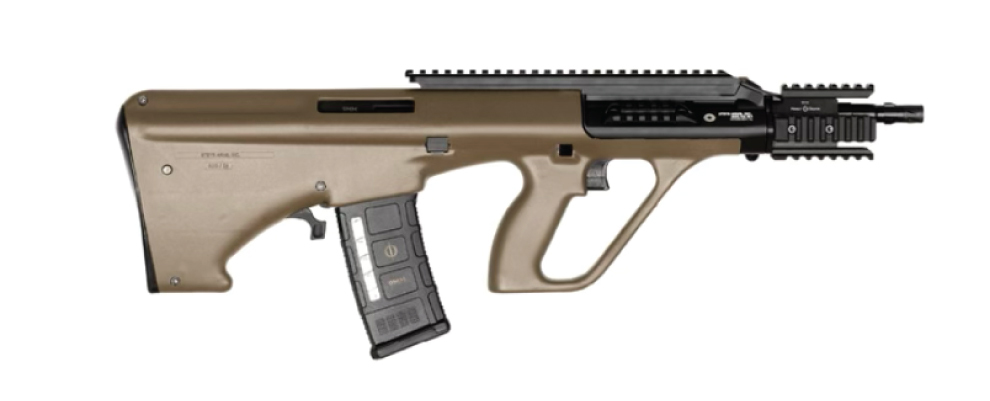
Many subsequent rifles — including the FAMAS, QBZ-95, and Tavor TAR-21 — borrowed ideas from the AUG.
Today, despite newer competitors, the AUG remains in service worldwide and continues to be updated for modern use. Its durability, simplicity, and forward-thinking design have ensured it remains a relevant platform nearly 50 years after its debut.
Caliber Compatibility
The Steyr AUG is chambered in .233 and/or 5.56 calibers. Due it continued popularity, many many engineers who happen to be fans started developing components that can fire off other calibers that one can swap out for the native kit.
- See here 9mm Steyr AUG conversion kit
Conclusion
The Steyr AUG is more than just an unusual-looking yet cool rifle — it’s a cornerstone of modern firearm design. From the battlefields of Afghanistan to urban special ops missions, the AUG has proven itself time and again.
Whether in its Standard configuration with proprietary magazines or the NATO variant built for compatibility, the AUG stands as one of the most innovative assault rifles in history. Its longevity is a testament to smart design, quality manufacturing, and a willingness to break from convention in pursuit of battlefield excellence.